Technique
BJJ Submissions: Full List and Chart by Position and Belt
Every common BJJ submission by family, the positions each one starts from, the IBJJF and ADCC rules by belt and age, and match data on which ones finish.
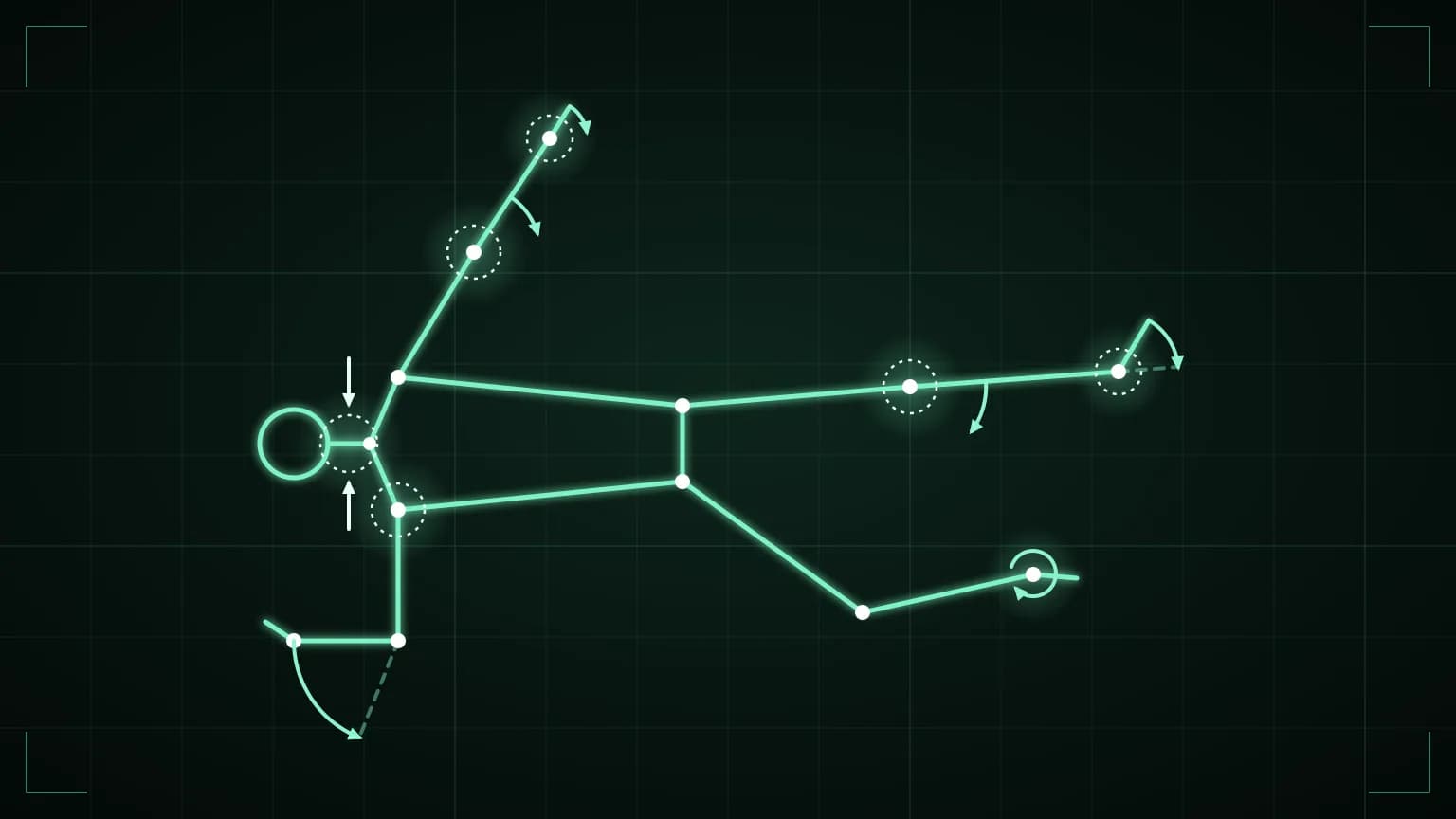
BJJ submissions come in five families: chokes, arm locks, shoulder locks, wrist locks and leg locks. Learn the rear naked choke, cross collar choke, guillotine, triangle, arm triangle, armbar, kimura, americana and omoplata first: together they cover mount, side control, guard and the back, and an adult white belt may use every one of them under IBJJF rules.
The rest open up with belt and age. Under IBJJF rules, you wait until blue belt for wrist locks, brown belt for kneebars and toe holds, and adult brown or black belt in no-gi for heel hooks. Below you get the positions each submission starts from, the divisions that allow it and the match data on which finishes land.
Know the five submission families
Each family attacks one structure, which tells you what to protect.
| Family | What it attacks | Submissions you meet first |
|---|---|---|
| Chokes | Blood flow through the sides of the neck, or the windpipe | Rear naked choke, cross collar choke, guillotine, triangle, arm triangle |
| Arm locks | The elbow, bent backward past straight | Armbar, bicep slicer |
| Shoulder locks | The shoulder, twisted inward or outward | Kimura, americana, omoplata |
| Wrist locks | The wrist, bent past its range | Wrist lock from closed guard, mount or side control |
| Leg locks | The ankle, the knee and the calf | Straight ankle lock, kneebar, toe hold, heel hook, calf slicer |
Judo names the same holds in Japanese: the International Judo Federation lists the armbar as juji-gatame, the triangle as sankaku-jime and the rear naked choke as hadaka-jime.
Two rules shape the choke family. The IBJJF Rules Book makes it a severe foul to strangle without the gi using your hands around the neck, or to press the windpipe with your thumb (Article 6.2.3, item I). The ADCC rules allow any choke except closing the windpipe with your hand.
Use the chart: every common submission and where it starts
The IBJJF column reads the table of illegal moves on page 29 of the Rules Book. "Every division" means the table bans the hold nowhere.
| Submission | Family | Where it starts | IBJJF: who may use it | Guide |
|---|---|---|---|---|
| Rear naked choke | Choke | Back control, turtle | Every division | Rear naked choke guide |
| Bow and arrow choke | Choke, gi only | Back control, turtle | Every division | |
| Cross collar choke | Choke, gi only | Closed guard, mount | Every division | |
| Guillotine | Choke | Front headlock, closed guard, half guard | From age 16 | Guillotine guide |
| D'arce choke | Choke | Front headlock, half guard top, turtle | From age 16, read with the arm triangle row | D'arce guide |
| Anaconda choke | Choke | Front headlock, turtle | From age 16, read with the arm triangle row | |
| Arm triangle | Choke | Mount, side control, half guard top | From age 16 | Arm triangle guide |
| North-south choke | Choke | North-south | Every division | |
| Ezekiel choke | Choke | Mount, back, inside the guard | From age 16 | |
| Triangle | Choke | Closed guard, open guard, mount | Every division; pulling the head down from age 16 | Triangle guide |
| Armbar | Arm lock | Closed guard, mount, side control, back | Every division | Armbar guide |
| Bicep slicer | Arm lock | A bent arm in the armbar, the back | Brown and black belts, adult and master | |
| Kimura | Shoulder lock | Closed guard, half guard, side control, north-south | Every division | Kimura guide |
| Americana | Shoulder lock | Side control, mount, half guard top | Every division | Americana guide |
| Omoplata | Shoulder lock | Closed guard, open guard | From age 16 | Omoplata guide |
| Wrist lock | Wrist lock | Closed guard, mount, side control | Blue belt and up, adult and master | |
| Straight ankle lock | Leg lock | Open guard, single leg X | From age 16, every belt | Leg locks guide |
| Kneebar | Leg lock | Half guard top, leg drag | Brown and black belts, adult and master | |
| Toe hold | Leg lock | Half guard top, open guard | Brown and black belts, adult and master | |
| Calf slicer | Leg lock | The truck, back takes | Brown and black belts, adult and master | |
| Heel hook | Leg lock | Inside and outside leg entanglements | Adult brown and black belts, no-gi only | Heel hook guide |
| Twister | Spine lock | The truck, the back | No IBJJF division |
The d'arce and the anaconda trap the head and one arm, like the arm triangle, which the table bans under 16. Ask your event before a kids or teen match.
See the submission map by position
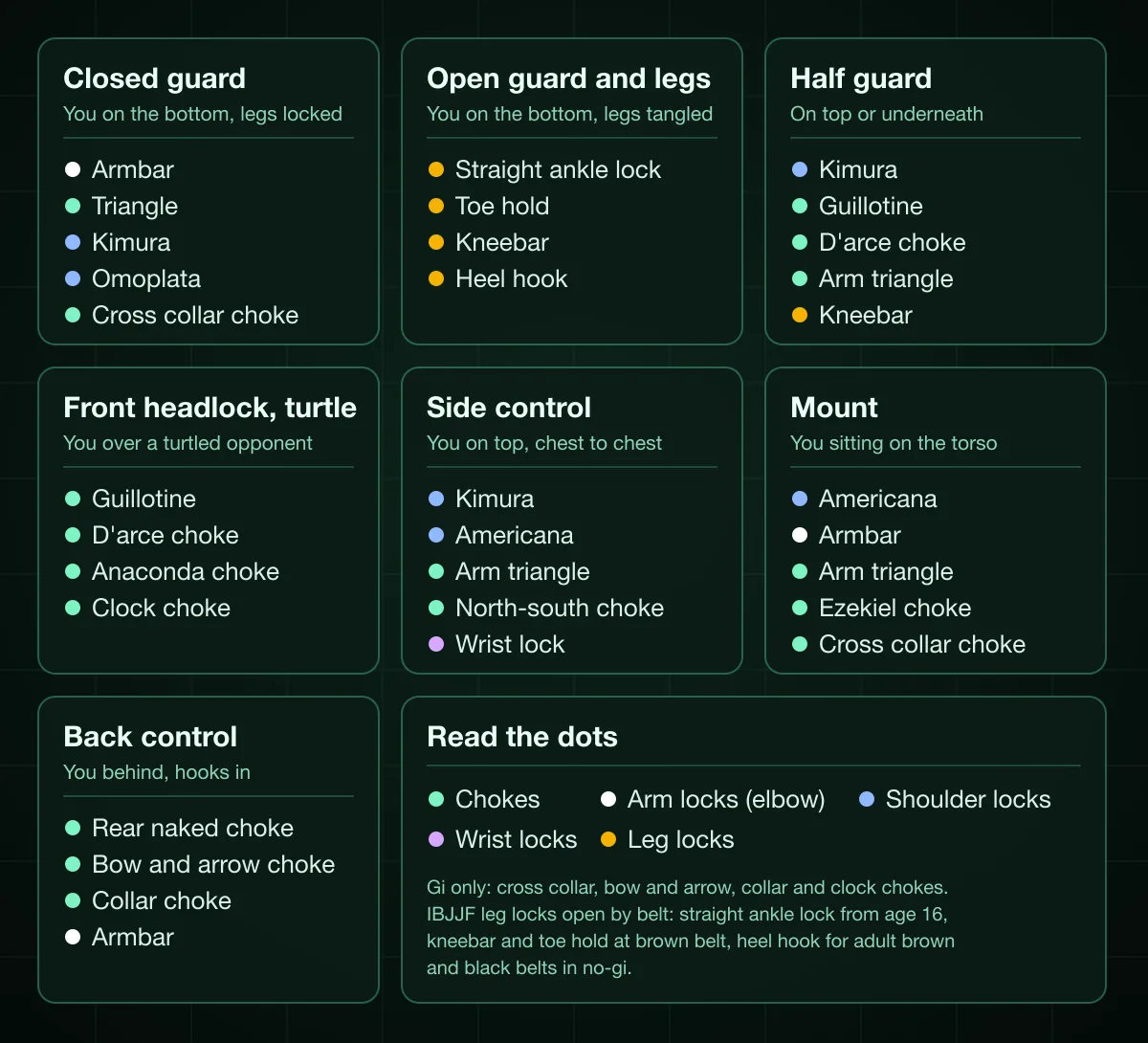
Read the map as a ladder. The top row holds the places you start from underneath or square on, and the lower rows the places you control from on top or behind. The IBJJF scores that climb: 3 points for passing the guard, 4 for mount and 4 for back control (Article 2.5.2). Each position you win adds finishes to your list.
Finish from mount
Mount gives you gravity and both of your opponent's arms in front of you. Start with these four:
- Americana. Pin the wrist beside the head, thread your other arm under the elbow, grab your own wrist and slide their wrist along the mat toward the hip.
- Armbar. When they push on your chest, climb high, step around the head and fall back with the arm between your knees and the thumb pointing up.
- Arm triangle. When an arm crosses your centerline, drive it across their neck with your head, slide off to the side and squeeze.
- Cross collar choke or Ezekiel. Feed a deep collar grip in the gi. Without the gi, choke with your forearm and your own wrist.
When they turn away to escape, take the back and switch to the rear naked choke.
Finish from side control
Side control leaves the near arm and the head open.
- Kimura. Catch the near wrist, thread a figure four and take the wrist behind the back.
- Americana. Use the same figure four with the opposite twist, the wrist sliding toward the hip.
- North-south choke. Walk around the head to north-south, wrap the neck with your arm and sink your chest.
- Arm triangle. When the near arm comes up to frame, trap the head and arm together and slide to the far side.
- Wrist lock. When they frame with a bent wrist, fold the hand toward the forearm. IBJJF events allow it from blue belt.
Finish from closed guard
Closed guard is where most lower belts attack. In white and blue belt gi matches, Williams and colleagues found that at least 76% of armbar, cross collar choke and triangle attempts started from the bottom of the guard.
- Armbar. Hold the arm across your chest, swing your hips out and bring your leg over the head.
- Triangle. Trap one arm inside your legs and one outside, lock your legs behind the neck, then pull the head down. Under 16, IBJJF rules let you lock the triangle without pulling the head.
- Kimura. When they post a hand on the mat, sit up, catch the wrist and lock the figure four.
- Omoplata. Swing your leg over the arm, sit up beside them and lean forward to twist the shoulder.
- Guillotine. When they drop the head, wrap the neck and close your guard. In the gi, the cross collar choke works from here too.
Finish from the back
The back take gives you the best odds in the data. At the elite level, Lamas and colleagues coded all 93 matches of the 2019 ADCC World Championship and found that the back take had the highest probability of leading straight to a submission: 0.45.
- Rear naked choke. Slide your choking arm under the chin until your elbow sits under it, grip your other biceps and expand your chest.
- Bow and arrow choke. In the gi, grip the collar deep, catch a leg and stretch them out.
- Collar choke. In the gi, feed the collar from behind and pull your elbow back.
- Armbar. When they defend the neck with both hands, swing your leg over their face and take the arm.
Finish from half guard, turtle and the front headlock
Chokes rule the scrambles.
- Half guard, bottom: the kimura when they post a hand, the guillotine when the head drops.
- Half guard, top: the d'arce and the arm triangle when the near arm comes up, plus the kneebar and toe hold at brown belt.
- Front headlock: the guillotine, d'arce and anaconda when a takedown fails and the head stays in front of you.
- Turtle: the clock choke in the gi, or hooks in for the back and the rear naked choke.
Attack the legs when your belt allows it
Leg locks carry the strictest belt rules in the IBJJF book.
- Straight ankle lock: legal from age 16 at every belt, white belts included. Turning toward the free foot while you hold it stays illegal until brown belt.
- Kneebar, toe hold, calf slicer: brown and black belts in adult and master divisions.
- Heel hook and knee reaping: adult brown and black belts in no-gi only. The table bans both in every gi division and in master no-gi.
- Twister: the IBJJF bans a spine lock without a choke in every division.
ADCC draws different lines: its rules allow any leg lock or ankle lock and the twister, while its Open events ban heel hooks for masters at beginner and intermediate level and in every kids and teen division.
Leg locks injure ankles and knees. In the survey by Hinz and colleagues, 60.9% of ankle ligament injuries happened during submissions, led by toe holds (14 athletes), straight ankle locks (8) and heel hooks (6). Drill them slowly with a coach present, and read the leg locks guide and the heel hook guide before you add them to your rolls.
Check what your belt and age allow
The table copies the six columns of the IBJJF illegal-moves table. "Yes" means legal in that division.
| Submission | Ages 4 to 12 | Ages 13 to 15 | Ages 16 and 17, and adult white belts | Blue and purple belts, adult and master | Brown and black belts, gi and master no-gi | Brown and black belts, adult no-gi |
|---|---|---|---|---|---|---|
| Rear naked, cross collar, bow and arrow and north-south chokes, armbar, kimura, americana | Yes | Yes | Yes | Yes | Yes | Yes |
| Leg splits that stretch the legs apart | No | Yes | Yes | Yes | Yes | Yes |
| Ezekiel, front guillotine, arm triangle, triangle while pulling the head, a choke that also bends the spine | No | No | Yes | Yes | Yes | Yes |
| Omoplata, straight ankle lock | No | No | Yes | Yes | Yes | Yes |
| Wrist lock, squeezing the kidneys or ribs with your closed guard | No | No | No | Yes | Yes | Yes |
| Bicep slicer, calf slicer, kneebar, toe hold | No | No | No | No | Yes | Yes |
| Heel hook, knee reaping, locks that twist the knee | No | No | No | No | No | Yes |
| Slams, spine locks without a choke, bending fingers back | No | No | No | No | No | No |
A banned hold ends your match. The rule book calls it a severe foul (Article 6.2.3, item M), and Article 7.1 disqualifies you from the match on the spot. Pick your belt, age and uniform in the IBJJF illegal techniques checker to see every row that applies to you.
ADCC Open events set their own kids rules. At 12 and under, you may not use the straight ankle lock, kneebar, wrist lock, Ezekiel or standing guillotine, and the straight ankle lock opens only for advanced juveniles aged 15 to 17.
Pick submissions with the best odds
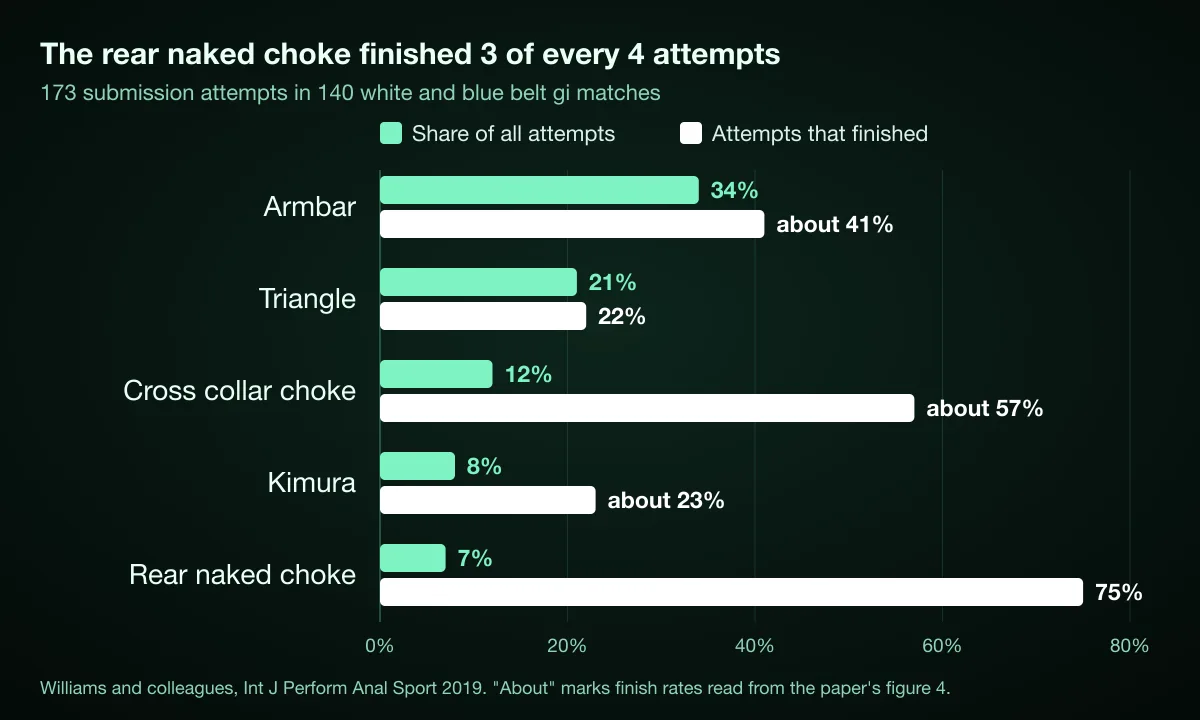
Williams and colleagues logged 173 submission attempts in 140 white and blue belt gi matches. The armbar drew 34% of the attempts, the triangle 21%, the cross collar choke 12%, the kimura 8% and the rear naked choke 7%. The rear naked choke finished 75% of the time and the triangle 22%, and the authors saw the least used finishes succeed more often.
Chokes take over when strikes come in. Stellpflug and colleagues reviewed every fight-ending choke in UFC history up to their study: 904 chokes, 76.2% of all grappling submissions, with the rear naked choke at 49.1% of them.
Take the back and finish with the choke, and use the armbar and the triangle from guard to force the openings. The samples stay small, so let your own log have the final word.
Tap early and train your finishes safely
Submissions injure the person who gets caught far more often than the person who applies them. Hinz and colleagues surveyed 1140 athletes who reported 1052 injuries that cost at least 2 weeks of training. Sparring caused 77.6% of them and submissions 29.7%. Of the submission injuries, 78.9% hit the athlete caught in the hold, led by the armbar (22.4%), the kimura (12.6%) and the heel hook (11%). Attackers got hurt too: the triangle caused 19 of the 66 injuries athletes reported while applying a submission.
Chokes carry their own record. In a survey of 4307 grapplers by Stellpflug and colleagues, 27.8% had been choked unconscious and 0.05% reported lasting symptoms. The same team later described 10 cases of torn neck arteries or strokes after sportive chokes. Self-reported forum answers and a case series cannot give you a true rate, so read both as warnings with limits.
The IBJJF counts four ways to submit (Article 2.1): tap twice with your hand on your partner, the mat or yourself; tap the mat twice with your foot when your arms are trapped; say you give up; or cry out in pain. Train with these defaults:
- Agree on the tap before every drill, and let go as soon as you feel or hear it.
- Apply every finish slowly, and never add a squeeze after the tap.
- Tap to leg locks and shoulder locks when the position locks in, before pain arrives.
See a physician at once, or call emergency services, if a new headache, neck pain, blurred vision, weakness or numbness on one side, slurred speech or trouble walking follows a choke: these can signal a torn artery. Book a physician for any joint that swells, locks or stays painful for more than a few days.
Fix the mistakes that cost you the finish
| Mistake | Fix |
|---|---|
| You attack before you hold the position, and they escape both | Hold the position for 3 seconds, then attack |
| You squeeze a choke with your arms alone and tire | Close the space first: chin cleared, elbow under the chin, chest tight to their back |
| You let the elbow slip out of the armbar | Pinch your knees, keep the thumb up and keep your hips tight to the shoulder |
| You chase one finish, and they defend it early | Chain two from the same grip: armbar to triangle, kimura to americana |
Common questions
How many submissions are there in BJJ?
Nobody keeps an official count. Almost every finish belongs to one of five families: chokes, arm locks, shoulder locks, wrist locks and leg locks, and the chart above covers the 22 you meet most often.
What is the most common submission in BJJ?
In white and blue belt gi matches, the armbar drew the most attempts, 34% of the total, and the rear naked choke finished most often, 75% of the time.
What submissions can white belts do?
Under IBJJF rules, an adult white belt may use every choke on this page, the armbar, the kimura, the americana, the omoplata and the straight ankle lock. Wrist locks wait until blue belt, kneebars, toe holds and slicers until brown belt, and heel hooks until adult brown or black belt in no-gi.
What is the best submission from mount?
Start with the americana and the armbar, then add the arm triangle and the cross collar choke. When your opponent turns away to escape, take the back.
Check the sources
- IBJJF Rules Book, version 6.1 (June 2024): Articles 2.1, 2.5.2, 6.2.3 and 7.1, illegal-moves table on page 29
- IBJJF illegal moves chart, January 2024
- ADCC Rules and Regulations, PDF dated 19 October 2026
- International Judo Federation technique pages: Juji-gatame, Sankaku-jime, Hadaka-jime
- Williams and colleagues, Int J Perform Anal Sport 2019;19(3):353-369: technique use in white and blue belt matches, accepted manuscript
- Lamas and colleagues, Int J Sports Sci Coach 2024;19(4):1767-1775: a Markovian analysis of elite no-gi matches
- Hinz and colleagues, Orthop J Sports Med 2021: injuries in 1140 BJJ athletes
- Stellpflug and colleagues, Phys Sportsmed 2020: the safety of sportive chokes
- Stellpflug and colleagues, J Emerg Med 2022: artery dissections and strokes after sportive chokes
- Stellpflug and colleagues, Phys Sportsmed 2022: fight-ending chokes in UFC history
- Grappling AI: Mat Coach on Google Play