
Technique
Lock a D'Arce Choke: Step-by-Step Setup and Fixes
Learn the D'Arce choke step by step: the front headlock entry, the figure-four grip, how it differs from the anaconda and guillotine, mistakes and drills.
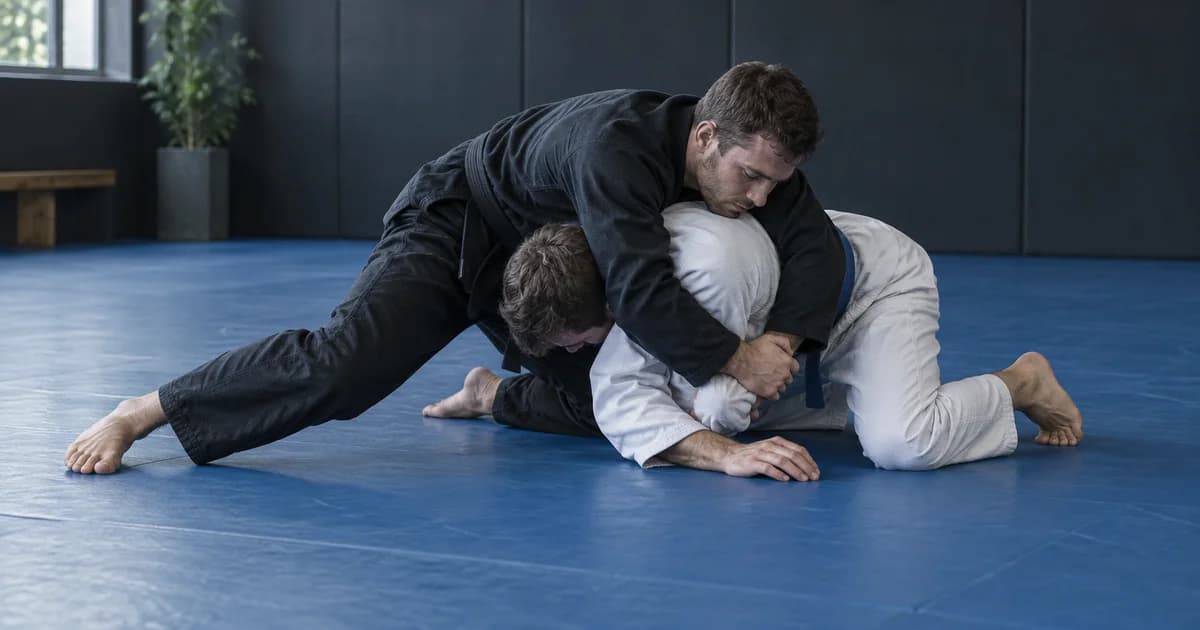
The D'Arce choke works from a front headlock: you thread your choking arm under your opponent's near armpit and across the front of their neck, lock a figure-four grip with your other hand, and compress both sides of their neck using your forearm and their own shoulder as the second point of pressure. It is named after Joe D'Arce, who popularized it at Renzo Gracie's academy in the early 2000s, though several coaches are credited with developing or naming it, and the gi version of the same choke is usually called the Brabo choke. This guide walks through the setup step by step, compares it with the anaconda and guillotine, and covers the mistakes that let opponents slip out before you finish.
Lock a D'Arce choke step by step
- Get a front headlock. This usually comes from sprawling on a takedown attempt or from an opponent turtling after a failed shot. Control their head under your armpit before you go looking for the choke.
- Thread your arm under their near armpit. Reach your choking-side arm underneath the arm closest to you and bring it across the front of their neck.
- Lock the figure-four grip. Grab your own bicep or wrist with your free hand, trapping their neck and the arm you threaded under in the same loop. Check that the loop is snug before you move to the next step.
- Adjust your head position. Keep your head on the same side as your choking arm to stop your opponent from turning into you and slipping their head free.
- Drive your hips and circle toward the choking side. Moving your hips away from your opponent while circling tightens the choke without needing extra arm strength.
- Squeeze by closing the whole frame. Pull your elbow in and let the compression come from your arm, their shoulder and your grip working together.
Compare the D'Arce with the anaconda and the guillotine
| Choke | Entry | Arm threading | Typical finish |
|---|---|---|---|
| D'Arce | Front headlock | Choking arm goes under the near armpit, then in front of the neck | From top or side control, without rolling |
| Anaconda | Front headlock | Choking arm goes under the neck first, then outside the far armpit | Usually finished by rolling over the trapped arm |
| Guillotine | Front headlock or guard | Arm wraps directly around the front of the neck, no armpit threading | From guard or standing, no roll required |
All three come from a similar front headlock position, which is why mixing them up is common early on. Our guillotine choke guide covers the simplest of the three in the same step-by-step depth as this page covers the D'Arce, and the arm triangle choke guide covers the side-control version of a related family of neck-and-arm chokes.
When the D'Arce shows up
The D'Arce most often appears in scrambles: a sprawl against a takedown, a failed single or double leg where your opponent's head ends up trapped, or a guard pass where your opponent turtles to escape. Wrestlers who cross-train in grappling tend to find the D'Arce naturally, since the front headlock position itself is already a core part of wrestling defense, and it is one of the clearest examples of a wrestling instinct turning directly into a submission once grips are added on top of it.
How to defend a D'Arce choke
Defense starts before your opponent ever locks the grip. The moment you feel an arm threading under your armpit toward your neck, turn your head and chin away from the threading arm rather than toward it, which makes the front-of-neck compression much harder to complete. Pummel your trapped arm free or post it against your opponent's hip to create space before the figure-four grip closes. If the grip does close, drive forward into your opponent rather than pulling back, since pulling away tightens the choke while driving forward can flatten them out or create room to posture up. Hip escapes and standing up out of the headlock both work once you have bought that initial space.
Fix the common D'Arce mistakes
| Mistake | Why it happens | Fix |
|---|---|---|
| Arm not deep enough under the armpit | Rushing the grip before the headlock is secure | Control the head fully first, then thread the arm deliberately |
| Squeezing with the bicep alone | Treating it like a bear hug instead of a frame | Pull your elbow in and circle your hips instead of relying on arm strength |
| Head on the wrong side | Not adjusting position after the initial entry | Keep your head stacked on the same side as your choking arm throughout |
| Letting go when the opponent defends | Losing the grip under resistance instead of repositioning | Maintain the figure-four and adjust your hips and angle before you consider releasing |
| Flattening out instead of finishing from a dominant position | Chasing the submission without securing position first | Secure top position or side control before committing fully to the finish |
Drill a reliable D'Arce in 5 steps
- Position-only drill. Start in a front headlock with no resistance and practice threading the arm and locking the figure-four grip until it feels automatic.
- Isolated grip drill. With a cooperative partner already in the correct position, practice only the hip circle and elbow pull that finishes the choke.
- Defense-aware drill. Have your partner defend the grip at light resistance so you learn to adjust your angle instead of forcing a stuck position.
- Scramble entry drill. Start from a sprawl position after a mock takedown attempt so you practice finding the front headlock under realistic, live movement.
- Live rounds from the headlock. Once the mechanics are solid, start live grappling rounds from a front headlock position so both the attack and the escape get real repetitions.
Always train chokes with a partner you trust, tap early and tap often, and release the choke the instant your partner taps. Learn new finishing details from a qualified instructor rather than guessing from video alone, especially while you are still building the position sense this choke depends on. If you are new to grappling generally, our BJJ for beginners guide covers the fundamentals this technique builds on.
Common questions
Is the D'Arce choke the same as the Brabo choke?
They use the same arm threading and figure-four grip. The difference is grip style: the D'Arce is typically done no-gi, gripping your own arm, while the Brabo choke is the gi version, which can also use the opponent's collar or sleeve for the grip.
What is the difference between a D'Arce and an anaconda choke?
Both start from a front headlock, but the D'Arce threads the choking arm under the near armpit and in front of the neck, finishing from top position, while the anaconda threads under the neck first and outside the far armpit, usually finishing by rolling over the trapped arm.
Why does my D'Arce choke keep slipping off?
Slipping almost always comes from the arm not being threaded deep enough under the armpit before you lock the grip, or from your head drifting to the wrong side and letting your opponent turn into the choke. Secure the headlock fully before you commit to the grip.
Is the D'Arce choke legal in BJJ competition?
Yes. It is a standard submission in both gi and no-gi Brazilian jiu-jitsu competition at adult levels, under the same chokehold rules that apply to the guillotine, anaconda and arm triangle.