Training guides
Your BJJ for Beginners Guide: First Class to First 90 Days
BJJ for beginners, step by step: pack for your first class, learn the positions and five solo movements, tap early, and follow a 12-week plan from day one.
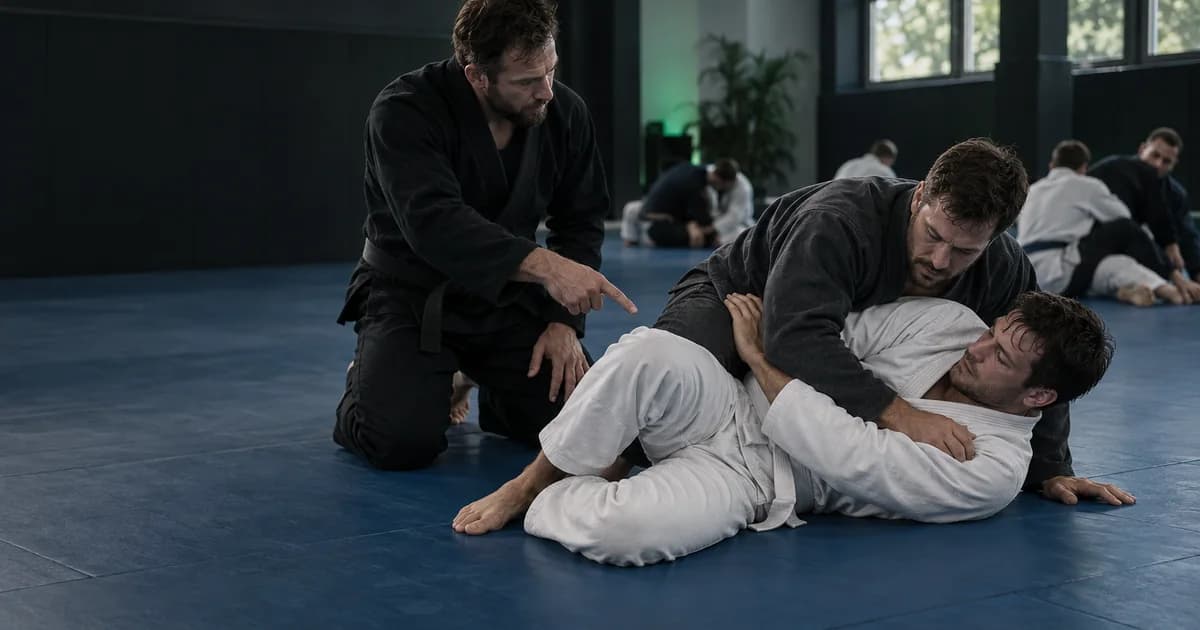
Brazilian jiu-jitsu (BJJ) for beginners starts with three jobs: survive bad positions, learn the position hierarchy, and tap early. Book a trial class, wear a rash guard and shorts or a borrowed gi, and train two to three times a week. Spend your first months on escapes, guard retention and five solo movements. Submissions come after you can stay safe underneath.
Here is what happens in your first class, the map of positions every roll follows, the solo movements to drill, and a 12-week plan.
Pack for your first class
You do not need much on day one. Many academies lend you a gi for a trial class, and no-gi classes only need a rash guard and shorts without pockets or zippers.
| Bring | Why |
|---|---|
| Rash guard and shorts, or a gi if you own one | Grips tear loose clothes and catch zippers |
| Flip-flops or slides | You wear shoes off the mat and bare feet on it, so you keep the mat clean |
| Water bottle | Rolling dehydrates you faster than you expect |
| Short, clean nails | Long nails scratch partners and tear |
| Mouthguard | It protects your teeth in scrambles and no-gi rounds |
Shower before class, wash your gear after every session, and skip training if you have a skin infection. Close contact spreads ringworm and staph fast, and your partners will thank you.
Know what happens in a beginner class
Most beginner classes follow the same four blocks:
- Warm-up. Jogging, then BJJ movements such as hip escapes, bridges and forward rolls.
- Technique. The coach shows one position or escape, and you drill it with a partner for several minutes per side.
- Positional sparring. You start in a set position, for example your partner in side control, and one of you tries to escape while the other holds.
- Open rolling. Many academies let brand-new students watch or roll lightly with a higher belt. Ask the coach before you join.
Tell every partner it is your first week. Good training partners slow down and help you learn.
Tap early, every time
Tapping ends a submission. You tap your partner or the mat at least twice, or say "tap" when your partner traps both your hands. Your partner releases at once.
Injury studies explain why this habit matters. In a survey of 881 practitioners, Stegerhoek and colleagues found that 89% of reported injuries happened in training, mostly during free sparring, and the knee and shoulder took the most damage. A survey of 1,287 adults by Moriarty and colleagues found that 59.2% reported at least one injury over six months, and less experienced athletes reported more head, upper-limb and elbow injuries.
Protect yourself with four rules:
- Tap when you feel the joint stop moving, before pain arrives.
- Say which injuries you carry before each roll.
- Skip explosive escapes from armbars and leg locks. Tap and reset instead.
- Pick calm partners for your first months. Higher belts usually control the pace best.
If an injury keeps hurting after training, see a sports medicine professional before you return to rolling.
Learn the positions every roll follows
BJJ follows a position hierarchy. You fight to reach the top positions, and you escape the bad ones before you worry about submissions. The IBJJF rulebook awards points for stabilizing a position for three seconds, so the points show the order of importance.
| Position | Who has the advantage | IBJJF points | Your first goal |
|---|---|---|---|
| Back control | The player behind, with hooks in | 4 | Protect your neck, then turn into your partner |
| Mount | The player sitting on the torso | 4 | Bridge and roll, or elbow-knee escape |
| Knee on belly | The player on top | 2 | Push the knee and shrimp away |
| Side control | The player on top across the chest | 3 for the guard pass that gets there | Frame on the hip and neck, then recover guard |
| Guard | The player on bottom, legs controlling | Neutral | Keep your knees between you and your partner |
| Takedown and sweep | Whoever finishes on top | 2 each | Stay on your feet, or come up on top |
Use the BJJ points calculator to practise scoring a round from video.
Do you plan to enter an ADCC event? Score a match with the ADCC points calculator, where a takedown, a pass and a sweep carry different values and the first half scores nothing.
Start with the closed guard guide to learn how you control posture, protect your position, and create your first attacks from the bottom.
Start underneath. Your first weeks should teach you to recover guard from side control, escape mount and defend your back. If you only learn submissions, you spend every roll stuck under someone heavier.
Once you know the positions, match each one to its finishes in the BJJ submissions chart, which marks the ones a white belt may use under IBJJF rules.
Drill the five movements that power every escape
These solo movements carry almost every escape you will learn. Drill them in every warm-up and at home on a mat. Our BJJ solo drills guide turns them into 10, 20 or 25 minute sessions.
- Hip escape (shrimp). Lie on your side, push off your bottom foot and drive your hips away from an imaginary partner. You use it to recover guard from side control and mount.
- Bridge (upa). Plant both feet close to your hips and drive your hips up and over one shoulder. You use it to knock someone off mount, and our mount escape guide turns it into a full escape.
- Technical stand-up. Post one hand behind you and the opposite foot in front, lift your hips and swing your back leg through. You use it to stand up safely in guard or open space.
- Forward and backward shoulder roll. Roll diagonally over one shoulder with your head tucked to the side. You use it to fall safely and recover guard.
- Frames. Push with your forearms and hands against the hip and neck line. Frames create the space your hip escape needs.
Follow a 12-week beginner plan
Train two or three classes a week and add one short solo session. Use this plan as a checklist alongside your academy's curriculum.
| Weeks | Focus | What you practise | Check before you move on |
|---|---|---|---|
| 1 to 2 | Basics and safety | Tapping, shrimps, bridges, technical stand-up | You tap early and move without panic |
| 3 to 4 | Escapes | Mount escape with bridge and roll, elbow-knee escape | You escape mount on a cooperative partner both sides |
| 5 to 6 | Side control and guard recovery | Frames, shrimp to guard, back defense | You recover guard in positional rounds at light resistance |
| 7 to 8 | Closed guard | Posture breaking, a scissor or hip bump sweep | You sweep a cooperative partner from closed guard |
| 9 to 10 | Top control | Hold side control and mount, knee on belly | You keep mount for 30 seconds against light escapes |
| 11 to 12 | First submissions | Armbar and kimura from control positions | You finish slowly and your partner never needs to tap in a hurry |
Keep a short training log after each class: the position, the one detail your coach corrected, and the one situation you lost most often in rolling. That note tells you what to ask at the next class.
When you reach submissions, start with the armbar and the kimura. Both teach you to control a position before you finish.
Choose gi or no-gi
Both teach the same positions. The gi slows the game down with collar and sleeve grips, so many coaches start beginners there. No-gi moves faster and relies on underhooks, wrist control and head position. Pick the class schedule you can attend every week, and add the other format later.
Leg locks deserve a note. The IBJJF restricts some leg attacks, such as heel hooks, by belt and age. Learn them from your coach, and read our heel hook guide before you try one.
Study the leg lock guide to recognize the main submission families, ashi garami positions, and adult IBJJF permissions before you enter that exchange.
Before your first tournament, pick your belt and age division in the IBJJF illegal techniques checker and read every move the rule book bans for you.
Entering a NAGA event instead? Find your age category, weight class and skill level with the NAGA division finder.
Understand the adult belt path
The IBJJF adult path runs white, blue, purple, brown, then black. Each belt below black divides into four degrees, which most academies show as stripes, and the IBJJF leaves that stripe system to each professor. For adults, white belt has no minimum time, blue belt requires at least two years before purple, purple requires at least one and a half years before brown, and brown requires at least one year before black. Your professor decides when you move up. Our BJJ belt system guide explains stripes and age rules.
Common questions
How long does it take to get good at BJJ?
It depends on how often you train and how well you recover. Under IBJJF rules, an adult needs at least two years at blue belt, one and a half at purple and one at brown before the next belt, so black belt is a long project. Measure your progress by what you survive and escape each month.
Can you start BJJ out of shape?
Yes. Beginner classes build your fitness while you learn. Tell the coach about any injury, rest between rounds, and scale your intensity up over your first weeks.
How many times a week should a beginner train BJJ?
Two to three classes a week gives you enough repetition to remember techniques and enough rest to recover. Add a short solo movement session if you want more practice without extra rolling.
Should you roll in your first class?
Only if the coach invites you and you roll with a calm, higher belt. Many beginners start with positional sparring, which teaches you more and carries less risk.
What is the first technique a BJJ beginner should learn?
The hip escape. It drives your guard recovery from side control and mount, and you can drill it alone every day.
Sources
- IBJJF. Graduation System
- IBJJF. Rules and books
- Stegerhoek PM et al. Injury prevalence among Brazilian Jiu-Jitsu practitioners globally: a cross-sectional study in 881 participants. BMJ Open Sport Exerc Med, 2025
- Moriarty C, Charnoff J, Felix ER. Injury rate and pattern among Brazilian jiu-jitsu practitioners: a survey study. Phys Ther Sport, 2019