Training guide
Learn the BJJ Belt Order: Ranks, Stripes and IBJJF Minimum Times
BJJ belts go white, blue, purple, brown, black. The IBJJF sets minimums: 2 years at blue, 1.5 at purple, 1 at brown, age 19 for black. See the full table.
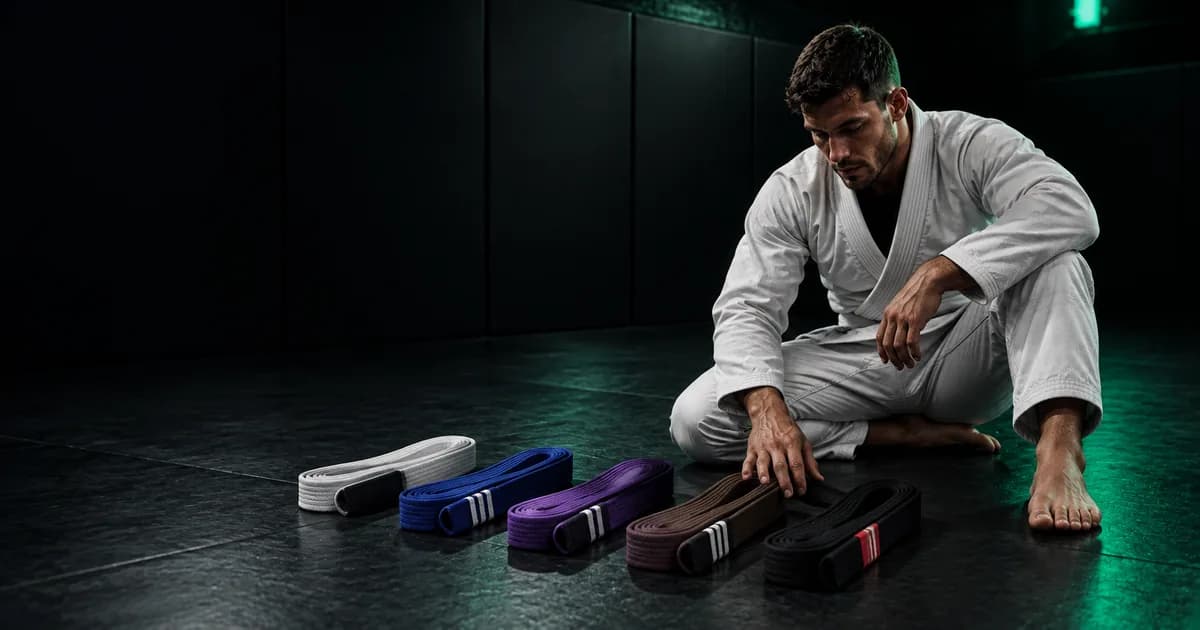
Adult Brazilian jiu-jitsu belts go white, blue, purple, brown and black. Black belt degrees follow, then the coral belts: red-and-black, red-and-white and red. Under the IBJJF graduation system you spend at least 2 years at blue, 1.5 years at purple and 1 year at brown, and you must be 19 to receive a black belt. Your instructor decides when you move up; these minimums only set the floor.
| Belt | Minimum age (IBJJF) | Minimum time at this belt before the next |
|---|---|---|
| White | None | None set by the IBJJF |
| Blue | 16 | 2 years |
| Purple | 16 | 1.5 years |
| Brown | 18 | 1 year |
| Black, up to the 2nd degree | 19 | 3 years per degree |
| Black, 3rd to 5th degree | 5 years per degree | |
| Black, 6th degree | 7 years | |
| Red-and-black (7th degree) | 7 years | |
| Red-and-white (8th degree) | 10 years | |
| Red (9th degree) | The 10th degree stays reserved for the Gracie pioneers |
Stripes mark progress inside a belt, and each academy sets its own stripe schedule. Check the current IBJJF graduation page before an event: the federation updates its rules.
Grappling AI: Mat Coach can support the review or log described here, but the sport rules, your coach, and your own recovery still set the boundary.
Separate rank, stripe, and competition eligibility
A belt color describes a rank in a system. Stripes can show progress toward the next rank, but academies differ in how they award, record, or skip them. A competition rulebook adds age, belt, uniform, and division requirements. It does not turn a color chart into an automatic promotion decision.
The adult sequence matters because many online charts combine children’s ranks, academy traditions, and competition language. Start by identifying whether you need a training explanation, an academy promotion question, or an event eligibility check.
Your belt also decides which techniques a tournament lets you use. Pick your belt in the IBJJF illegal techniques checker to read the rule book's list for your division.
Your belt sets your IBJJF match clock too, from 5 minutes at adult white belt to 10 at black belt, so roll your practice rounds at that length with the BJJ timer.
Adult sequence and common context
Use this table as a map. Confirm current eligibility with the event organizer and confirm promotion expectations with your academy.
| Rank or marker | Common adult context | What can vary | What to verify |
|---|---|---|---|
| White belt | Learning foundations and academy safety | Stripe schedule and technical syllabus | Instructor’s current expectations |
| Blue belt | Developing a broader game and reliable defense | Promotion timing and competition eligibility | Academy and event rules |
| Purple belt | More developed systems and transitions | Teaching expectations and stripe practice | Coach feedback and division rules |
| Brown belt | Refined game and higher technical responsibility | Promotion route and minimum periods | Federation or event requirements |
| Black belt | Advanced rank within the recognized system | Degrees, certification, and registration | Current federation criteria |
| Stripes | Progress marker inside the current belt | Number, timing, and meaning | Academy policy, not a universal law |
Use the plan in five steps
-
Ask the academy which promotion system and age category apply to you.
-
Read the current event rules separately if you plan to compete. Check the exact belt, age, gi, and division language. The IBJJF age division calculator gives you your division and match time from your birth year.
-
Log technical themes, attendance, and coach feedback as training evidence, not as a self-issued promotion claim.
-
Review filmed positions for one visible improvement, such as posture, grip, base, or transition timing.
-
Use the same terminology when you discuss progress with your instructor so the conversation stays about evidence and standards.
Film and review one comparable example
Grappling AI: Mat Coach can review recorded gi or no-gi movement for visible positions, grips, weight distribution, and transitions, and keep your training log. Use it to compare the same drill across sessions. It cannot award a belt, certify a rank, or replace your instructor’s assessment.
Film from an angle that keeps the relevant feet, hands, implement, or landing area visible. Record the date, version of the drill, load or intensity when relevant, and what the camera cannot show. Compare like with like before you change more than one variable.
Keep this intent separate
This page owns the belt system and the boundary between rank language and competition eligibility. Link to the solo-drills page for a home session, but do not use solo repetition as evidence that a belt requirement is complete.
Safety and scope
Train submissions, takedowns, and live resistance with qualified coaching and a consenting partner. Release at the first tap or verbal signal. Seek qualified medical care for a suspected head, neck, joint, or breathing injury.
Common questions
How many stripes are there in BJJ?
Many academies use four stripes within an adult belt, but practices vary. Treat stripes as an academy marker unless the relevant organization states another rule.
Does IBJJF award belts?
IBJJF rules govern competition categories and eligibility. Academy instructors or recognized promotion authorities handle the promotion decision.
Can I skip a belt?
Some instructors or systems may recognize prior experience or use a different promotion route. Ask the academy and keep competition registration separate from informal belt claims.
Sources and further reading
Related guides
BJJ solo drills at home · BJJ app comparison · grappling video review