Training apps
BJJ and Grappling Video Analysis App Workflow
Learn how to film complete exchanges, review one sequence at a time, identify visible decisions, and bring a precise question to your coach.
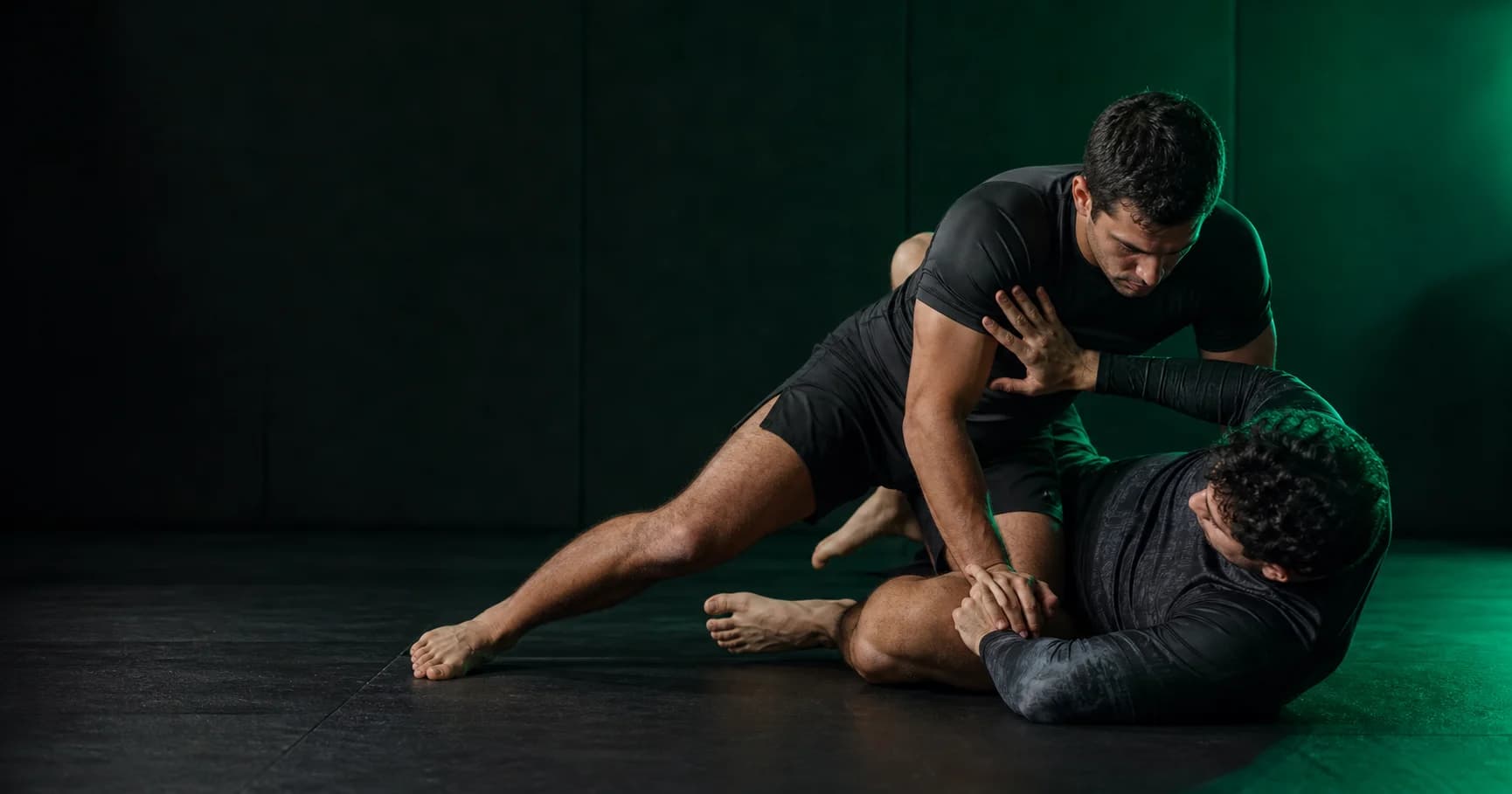
A useful roll review should answer three questions: where did the exchange begin, which visible decision changed it, and what will you test next time? Film enough context to see both grapplers, review one sequence at a time, and finish with one question for your coach. Do not try to explain an entire round with a single label such as bad guard or poor passing.
Start with a review question
Choose the question before you press play. This keeps you from watching the result repeatedly while missing the decision that produced it.
Useful questions include:
- When did my opponent begin controlling my upper body?
- Which grip did I fail to address before the pass?
- Where did I place my weight when my passing direction stalled?
- Did I expose my back during the transition or after the new position settled?
- Which defensive layer failed first: posture, inside position, frames, hip angle, or hand fighting?
Keep the question observable. Why am I bad at half guard? invites a vague answer. What changed between my knee shield holding and my shoulders becoming flat? directs you toward a reviewable sequence.
Film the whole exchange
Place the camera far enough away to keep both athletes in frame. A high corner angle usually preserves more information than a low camera placed beside the mat. Keep the lens clear of bags, bottles, and people walking along the edge.
Ask your coach and training partner before you record. Follow your academy's filming rules, and do not publish another person's training footage without permission.
Use these filming checks:
- Keep both athletes' hands and feet visible whenever the room allows it.
- Include enough mat around the athletes to capture scrambles and stand-up transitions.
- Avoid digital zoom because it removes context without improving the original detail.
- Keep the camera stable.
- Record the complete positional sequence, including the setup before the apparent mistake.
- Note which side faces away from the camera.
One angle will always hide something. If a body blocks the far arm, write far-arm position hidden instead of assuming what happened.
Review in three passes
Pass 1: Watch the round without stopping
Identify the broad structure. Note where the round begins, which positions occupy meaningful time, and where control changes. Do not diagnose every movement yet.
Create simple timestamps such as:
- 0:35 seated guard engagement
- 1:08 knee-cut attempt begins
- 1:19 shoulders flattened
- 1:27 pass stabilizes
- 2:42 back exposure during escape
These tags give you a map. They do not prove who made the better technical choice.
Pass 2: Isolate the decision point
Return to one transition and begin several beats before the visible outcome. A decision point is the moment when one grappler commits to an action or fails to answer a developing threat.
For example, do not begin your guard-pass review when the passer clears the legs. Begin when the passer wins a controlling grip, changes the angle, or places enough weight to limit hip movement. Ask:
- What position existed before the change?
- What did each grappler control?
- What action forced a response?
- What response appeared on video?
- Where did the exchange stabilize?
Separate the decision from the outcome. You can make a sound decision and execute it poorly. You can also get a favorable outcome because your partner pauses, slips, or chooses a different objective.
Pass 3: Compare repeated situations
Find another instance of the same position. Compare the frames just before the outcomes diverge.
If one knee-cut pass works and another stalls, compare head position, hip height, lead-foot placement, grips, and the guard player's frames. If one back escape succeeds and another exposes your neck, compare which hand you fought first, whether your shoulders reached the mat, and where your hips faced.
Repeated examples help you distinguish a pattern from an isolated event.
Tag positions without overclaiming
Use position tags that help you find footage later. You do not need to name every temporary shape as a formal position.
A practical tag can include:
| Field | Example |
|---|---|
| Starting position | Bottom half guard |
| Orientation | Opponent passing toward my right |
| Main controls | Crossface developing, top knee blocked |
| Decision | I reached for the far leg |
| Transition | Opponent flattened my shoulders |
| Resulting position | Side control |
| Confidence | Far-side arm partly hidden |
Treat confidence as part of the analysis. Use clear, partly obscured, or uncertain. This prevents you from building a training plan around an event that the footage never establishes.
Inspect weight distribution through visible cues
Video cannot measure pressure directly. You can still inspect visible evidence of how each grappler distributes weight.
Look for:
- Which hands, feet, knees, hips, shoulders, or head touch the mat or partner.
- Whether a posted limb carries enough apparent load to limit movement elsewhere.
- Whether the hips stay over a stable base or drift beyond it.
- Whether the torso angle changes before a pass, sweep, or escape.
- Whether one grappler can remove a post without collapsing or stepping.
- Whether the bottom athlete's shoulders and hips can rotate independently.
Write what you see. Passer moved chest over my upper body as the lead knee cleared is stronger than passer had heavy pressure. The second statement may describe what you felt, but the video alone cannot establish it.
Track grips as a sequence
Do not list grips without timing. A grip matters because of what it prevents, enables, or forces next.
For each important exchange, record:
- Who establishes contact first?
- Which grip creates posture, angle, or connection?
- Which hand remains free?
- Does anyone strip, replace, or ignore the grip?
- What happens immediately after the grip changes?
In gi footage, distinguish collar, sleeve, belt, lapel, trouser, and body connections when the angle shows them. In no-gi footage, identify wrist control, elbow control, underhooks, overhooks, head position, and body locks without pretending that the image reveals grip strength.
If fingers disappear behind a torso, describe the visible relationship rather than guessing the exact grip.
Read transitions from stable position to stable position
A transition starts before the spectacular movement. Mark the first commitment and the point when the resulting control stabilizes.
Use this structure:
Starting control → first meaningful change → defensive response → adjustment → stable result
Example:
Open guard → passer pins lower leg → guard player frames at shoulder → passer redirects toward the opposite side → half guard
This format shows where you still had choices. If you review only the final position, every correction becomes escape sooner. A sequence gives you a specific checkpoint to train.
When competition scoring affects your interpretation, consult the current IBJJF rule book and update guides. Do not infer current scoring, legal techniques, or stabilization requirements from an old clip or a different ruleset.
What video cannot show
A responsible review preserves uncertainty. Footage cannot establish:
- Grip pressure or how secure a connection felt.
- Partner resistance, cooperation, or intent.
- Pain, numbness, dizziness, or other internal sensations.
- Fatigue or muscle activation.
- Instructions that happened off-camera.
- A hidden limb's exact position.
- Why a partner chose not to continue an available action.
Audio and a second angle can add context, but they do not remove every limitation. If your conclusion depends on invisible pressure or intent, convert it into a question for the people who participated.
For a submission-specific example, the rear naked choke review guide shows how to separate visible hand fighting and arm placement from sensations that a recording cannot capture.
Use a round-review worksheet
Complete one copy for one sequence. Stop after you define a testable next action.
| Prompt | Your entry |
|---|---|
| Round and timestamp | |
| Gi or no-gi | |
| Starting position | |
| My immediate objective | |
| Partner's visible objective | |
| First controlling grip or frame | |
| First change in weight or base | |
| Decision point | |
| My response | |
| Resulting stable position | |
| Hidden or uncertain detail | |
| Pattern seen elsewhere | |
| One question for my coach | |
| One action to test next session |
Avoid filling every cell with several paragraphs. The worksheet should help you retrieve the evidence quickly during class.
Bring one narrow question to your coach
Show the sequence from a few seconds before the decision through the stable result. State what you can see, identify what remains hidden, and ask one question.
Try this format:
I started in bottom half guard. At 1:08, my opponent began winning the crossface while I reached toward the far leg. The camera hides my far elbow. Should I recover inside position before I attack the leg, or should I change my hip angle first?
That question gives your coach a position, timestamp, observed action, uncertainty, and choice to evaluate. It also makes correction easier to remember.
Use the broader BJJ app comparison if you still need to decide whether video review, session tracking, or written notes should anchor your workflow. The site's grappling guide can help you organize the next topic you want to study.
If session tracking matters most to you, compare six training journals in our BJJ tracker apps breakdown.
Finish with one test
A useful review ends before your list becomes untrainable. Choose one visible checkpoint, design one positional starting point, and test the adjustment with a cooperative partner before increasing resistance.
After the next session, compare the new footage with the original sequence. Ask whether you made the intended decision earlier, not merely whether you won the exchange. That comparison turns a recording into a repeatable learning loop.