Technique
BJJ Guard Passing: How to Pass the Guard Step by Step
Pass the guard in BJJ: what counts as a pass under IBJJF rules, five passes with step-by-step cues, a drill plan and the match data on why passing wins.
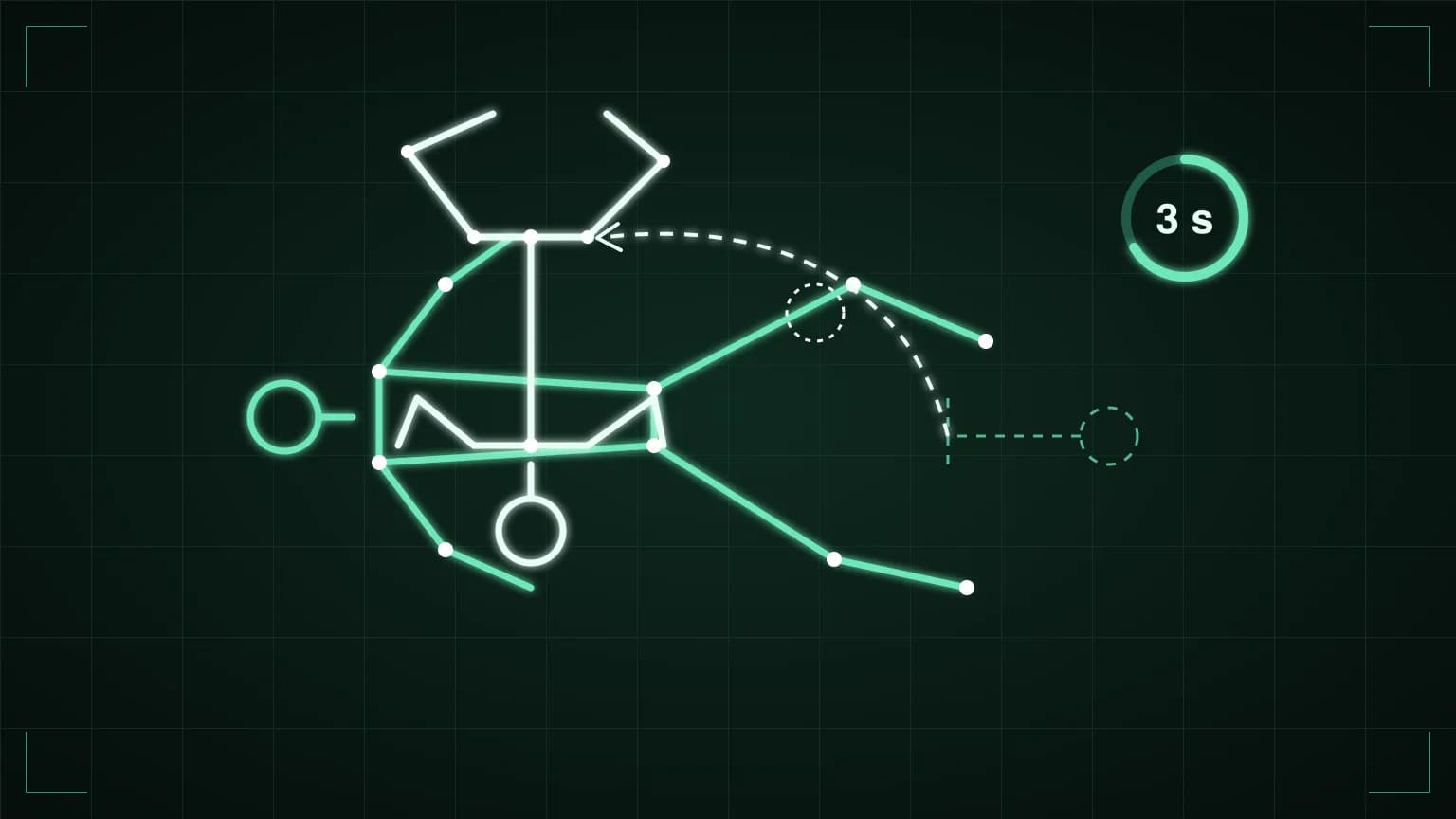
Guard passing means getting past your opponent's legs and holding side control or north-south for 3 seconds, which scores 3 points under the IBJJF rules. You pass by pinning the hips or the legs, beating the guard's grips and frames with pressure or speed, and settling your weight before you move on to mount or the back.
Below you get the exact rule that turns a pass into points, five passes that cover most guards with the cue that makes each one work, how to pass the half guard, a drill plan built on research, the mistakes that get you swept, and the match data on why the first pass matters so much.
Know what counts as a pass
The IBJJF Rules Book (version 6.1, June 2024) sets the rule in article 4.2. You score a guard pass when you get past the legs of your opponent's guard or half guard and hold side control or north-south over them for 3 seconds.
Four details decide whether your pass scores:
- The guard is the legs. Note 1 of article 4.2 defines guard as one or both legs blocking you from side control or north-south. Get past the legs, and you have passed.
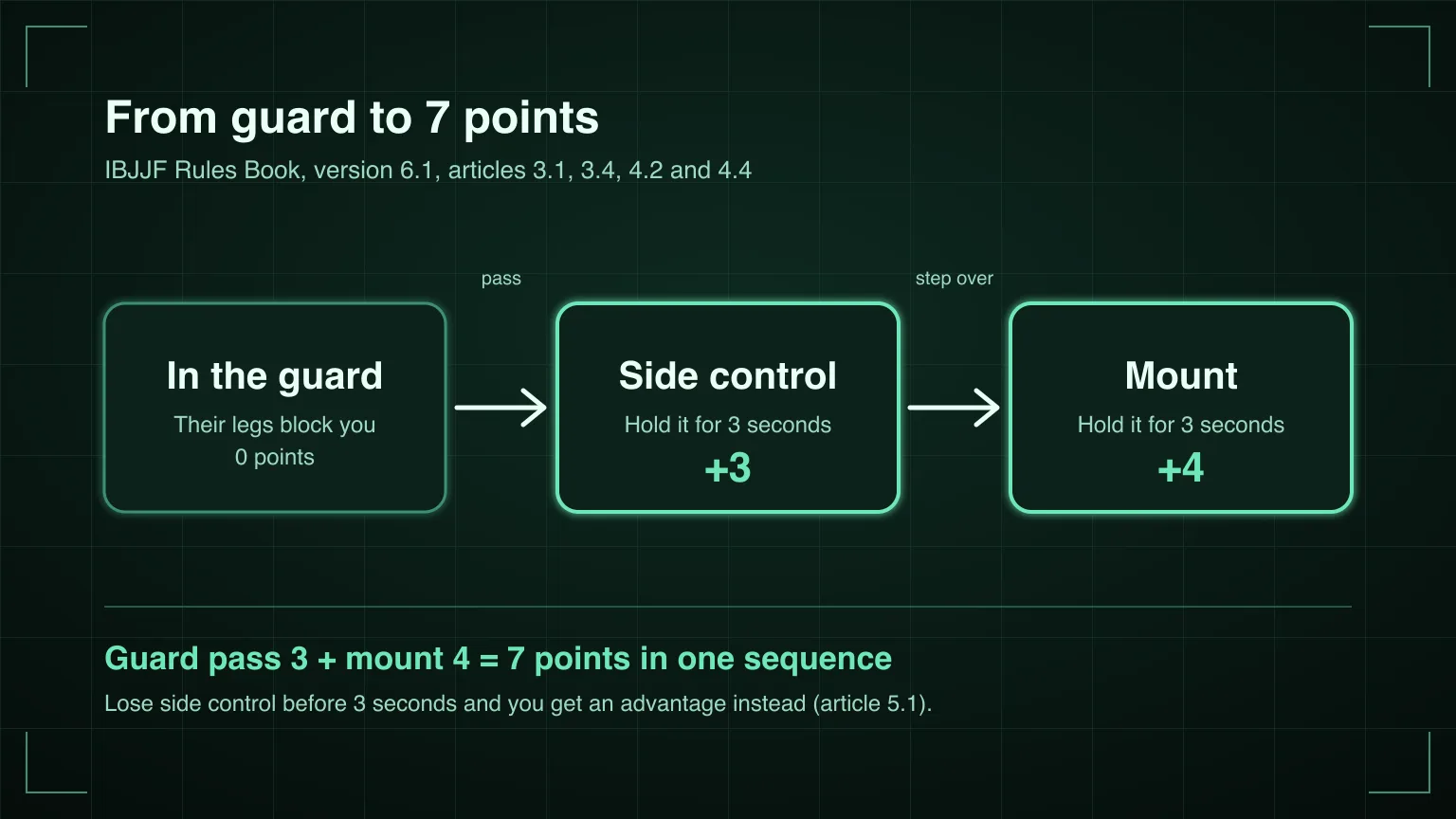
- Three seconds or nothing. Points need 3 seconds of stable control (article 3.1). Reach side control and lose it after a second and you get an advantage instead (article 5.1).
- Keep going for more. Pass, then slide to mount, and the points stack: article 3.4 gives 7 points for a guard pass followed by mount, counted from the 3 seconds at the end of the sequence.
- Half guard needs a real pass attempt. Reaching half guard on top earns no advantage unless it came from a guard pass attempt (article 5.7.2).
Score a few practice rounds with our BJJ points calculator and you will start to feel how much a clean pass changes a match.
Pick a pass for the guard in front of you
Passes fall into two families. Pressure passes pin your opponent's hips and crush space. Speed passes move the legs out of the way and run around them before the guard rebuilds.
| Pass | Family | Use it against | The one cue |
|---|---|---|---|
| Knee cut (knee slice) | Pressure | Open guard, half guard, butterfly | Drive your knee across the thigh to the mat while your chest stays heavy |
| Toreando (bullfighter) | Speed | Open guard with the feet on your hips | Grip both pants at the knees and push the legs to the mat before you run |
| Over-under | Pressure | Open guard with the legs high | One arm under a thigh, one over, stack the hips onto their shoulders |
| Leg drag | Speed | De La Riva and open guards with an extended leg | Pull the leg across your hip and pin it while you step around |
| Half guard smash | Pressure | Half guard | Crossface, win the underhook, flatten them, then free your trapped leg |
Start with two: one pressure pass and one speed pass. When your opponent fights the knee cut by turning in, the toreando is open. When they push you away to stop the toreando, the knee cut is open.
Against a closed guard you first need to open it. Read our closed guard guide for posture and the stand-up opening.
Cut the knee through the guard
- Control the near leg with a grip on the pants at the knee, and get an underhook or a collar grip on the far side.
- Put your near knee on their thigh, just above the knee, with your shin pointing across their body.
- Drive the knee across the thigh until it touches the mat on the far side. Keep your chest low and your weight over their hips.
- Slide your hips through and pin your near knee against their hip so they cannot turn in.
- Free your trapped foot last, then hold side control for 3 seconds.
The mistake: your knee cuts but your chest lifts. A light chest gives them room to turn in, find the underhook and come up. Keep your head on the far side of theirs.
Run the toreando around the legs
- Grip both pant legs at the knees, thumbs out.
- Push both knees toward the mat on one side, so their hips turn away from you.
- Step your body around to the other side while your hands keep the legs pinned.
- Drop your chest onto their chest before you let go of the legs.
- Hold side control for 3 seconds.
The mistake: you run before the legs touch the mat. Their hips still face you, their feet come back to your hips and the guard rebuilds. Pin first, then run.
Stack them with the over-under
- Shoot one arm under a thigh and the other arm over the other thigh, hands locked or gripping the belt.
- Lift their hips and walk your weight forward until their hips sit over their shoulders.
- Put your head on their stomach and pressure down, then walk around toward the under-arm side.
- Settle into side control with your hips low and hold it for 3 seconds.
The mistake: your head stays off their body. Without the head and shoulder pressure, they push your head away and swing a leg back in front of you.
Drag the leg past your hip
- Grab the pant leg or the ankle of their top leg.
- Pull that leg across your body so their knees point away from you, and pin it to the mat with your hip.
- Step around their legs toward their back, staying low.
- Switch your grip to the far hip or collar and flatten them, then hold the position for 3 seconds.
The mistake: you drag the leg but your hips stay high. A loose drag lets them spin to face you or take your back.
Pass the half guard
Half guard traps one of your legs. You win it in order: head, arms, then legs.
- Get a crossface: your forearm across their jaw, your head low on the far side.
- Win the underhook on the far side so they cannot come up on an elbow.
- Flatten them onto their back with your chest.
- Free your trapped leg by walking the knee out or pushing their bottom knee down with your free foot.
- Hold side control or switch straight to mount.
Change sides too. In a video study of half guard passing in competition, Okubo found that passers mostly passed to their left, yet passes to the right scored 36.70% of the time against 19.67% to the left. Your opponent defends the side they see most, so drill both directions until neither feels new.
Settle the pass before you chase the next one
A pass only counts after 3 seconds of control, and those 3 seconds are where most new passers lose it. Settle in this order:
- Hips low, chest heavy. Put your weight on their chest, not on your knees.
- Block the near hip. Your knee or your hand stops them from turning in to recover the guard.
- Kill the underhook. Pin their near arm so they cannot dig under and come up.
- Count three, then move. Mount or knee on belly scores again only after the pass is safe.
Once you hold side control, take it further with our guides to escaping side control, which shows you every escape your opponent will try, and to the BJJ submissions that start from the top.
See why the first pass matters
Match data back the time you spend on passing. Ferreira dos Santos and colleagues studied 211 women's bouts at the 2020 IBJJF Pan American Championship. In the 180 bouts with a first score, the athlete who scored first won 87.2% of the time. When that first score was a guard pass, the passer won 57 of 61 bouts, 93.4%, against 86.4% after a first sweep and 77.8% after a first takedown.
The pace of a match explains why your passing has to hold up under fatigue. Andreato and colleagues timed regional competition and found an effort to pause ratio of 6 to 1, with high-intensity actions lasting about 4 seconds and grip strength dropping after a single fight. In 422 women's bouts at the same 2020 event, Dos Santos and colleagues found that gripping, transition and attack times shift with weight class: the lightest division fought longer for grips than the heavier ones, so expect to win your grips before every pass.
Drill guard passing so it holds up in a match
Passing is hard work, and you can use it as conditioning. Rufino and colleagues gave athletes a guard passing test of 6 all-out sets. Heart rate, blood lactate and effort ratings matched a simulated BJJ match. Notational work by Coswig and colleagues adds that physical fitness explained a sizable share of what athletes did in simulated judo and BJJ matches, so your passing improves when your engine does.
A three-week plan, twice a week after class:
| Week | Drill | Rounds |
|---|---|---|
| 1 | Knee cut and toreando against a cooperative partner, 10 reps per side | 3 rounds of 3 minutes |
| 2 | Positional sparring: you start in their open guard, the round resets on a pass or a sweep | 5 rounds of 2 minutes |
| 3 | Same start, but you must hold side control for 3 seconds to score | 6 rounds of 2 minutes, all-out |
Run the rounds with our BJJ timer, and if you are new to the mat, read our BJJ for beginners guide first. Ready to test your passing at a tournament? Find your age category, weight class and skill level with the NAGA division finder.
Fix the mistakes that get you swept
- You reach with your hands on the mat. Posted hands give them a free sweep. Keep your hands on their hips, knees or collar.
- You pass with your head up. A high head means a light chest. Keep your head low and on the far side.
- You stand still inside the guard. The IBJJF rules update for 2024 defines stalling as clearly not pursuing positional progression, and the referee can penalize it. Keep working a grip, an angle or a pass.
- You rush the last step. Most passes fail in the last second. Settle and count three.
- You only pass to one side. The half guard data above show that the less common side scores more often.
- You ignore their grips. Strip the sleeve and collar grips before you pass, or the guard keeps pulling you back in.
Get quick answers
What is guard passing in BJJ?
Guard passing means getting past your opponent's legs, which form the guard, and holding side control or north-south on top. Under IBJJF rules a pass you hold for 3 seconds scores 3 points.
How many points is a guard pass?
Three points under the IBJJF Rules Book, article 4.2. Pass and then take mount, and you can score 7 points in one sequence (article 3.4).
What is the easiest guard pass for beginners?
The knee cut and the toreando cover most open guards, and they work as a pair. Learn one pressure pass and one speed pass, then switch between them when your partner blocks one.
How do you pass the half guard?
Crossface, win the underhook, flatten your opponent onto their back, then free your trapped leg and hold side control. Drill it to both sides.
Why do I keep getting swept when I pass?
Usually your hands touch the mat, your head is up or you rush the last step. Keep your hands on their legs or hips, your head low and your weight on their chest until you hold the position for 3 seconds.
Check the sources
- IBJJF Rules Book, version 6.1, June 2024
- IBJJF Rules Update Guide, valid from 1 January 2024
- Ferreira dos Santos, Ribeiro Almeida, Fernandes and colleagues, First scoring-event acquisition is associated with victory in female Brazilian jiu-jitsu, Sports, 2026
- Okubo, Lateral biases and the negative frequency-dependent advantage in half-guard passing in Brazilian jiu-jitsu, Laterality, 2025
- Rufino, Franchini, Forte and colleagues, Physiological and perceptual responses of a guard passing test and a simulated Brazilian jiu-jitsu combat, J Strength Cond Res, 2024
- Andreato, Franchini, de Moraes and colleagues, Physiological and technical-tactical analysis in Brazilian jiu-jitsu competition, Asian J Sports Med, 2013
- Dos Santos, Soto, de Brito and colleagues, Effects of weight divisions in time-motion of female high-level Brazilian jiu-jitsu combat behaviors, Front Psychol, 2023
- Coswig, Gentil, Bueno and colleagues, Physical fitness predicts technical-tactical and time-motion profile in simulated judo and Brazilian jiu-jitsu matches, PeerJ, 2018