Technique
Land Your First BJJ Sweep: 4 Guard Sweeps and the Timing Behind Them
Learn 4 beginner BJJ sweeps from closed and butterfly guard, the off-balancing idea behind all of them, common mistakes, drills and IBJJF scoring.
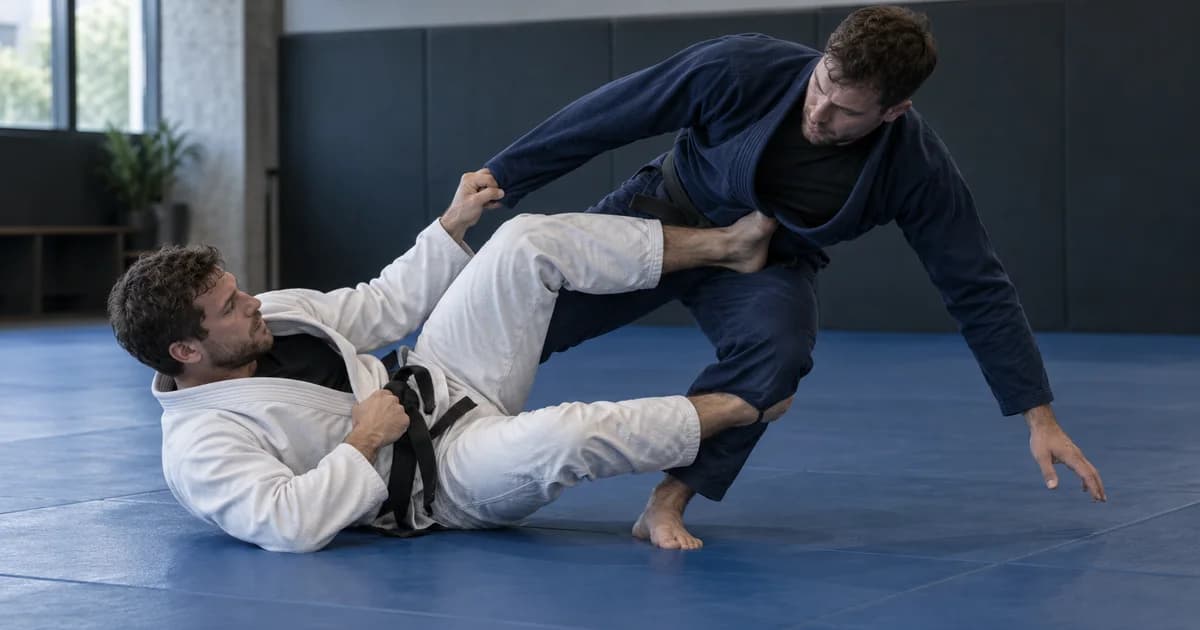
A BJJ sweep reverses your position from the bottom of guard to the top, and almost every version works the same way underneath: you remove or block one of your opponent's bases, usually a post hand or foot, while moving your own hips or legs in the direction that base can no longer stop. In IBJJF competition a completed sweep is worth 2 points, the same value as a takedown or a knee on belly. This guide covers four sweeps worth learning first, the off-balancing idea that makes all of them work, and the timing mistakes that turn a good sweep into a stalled one.
Off-balance your partner before every sweep
Your opponent stays upright because their base, the hands and feet touching the mat, can adjust to pressure from any one direction. A sweep works by taking away that option before you ever move. There are three common ways to do it:
- Remove a post. Control or off-balance a hand or foot your opponent needs to stay up, so they have nothing to catch themselves with when you move.
- Attack an angle they cannot post against in time. Moving your hips to a line their base is not covering beats trying to overpower a base that is already set.
- Borrow their own momentum. If your opponent is already pushing, pulling or standing, redirecting that movement is far easier than creating force from a dead stop.
Learn these 4 sweeps first
| Sweep | Guard | Off-balance mechanism | Key detail |
|---|---|---|---|
| Scissor sweep | Closed guard | Your legs scissor to take out your opponent's base leg while you turn into them | Break their posture forward before you open your guard |
| Hip bump sweep | Closed guard | You sit up and drive your hip into your opponent while their hands are posted low | Time the bump to when their weight is already forward |
| Pendulum (flower) sweep | Closed guard | A swinging leg motion off-balances your opponent as they try to stand or posture up | Use the momentum of the swing more than raw leg strength |
| Butterfly hook sweep | Butterfly guard | A hook elevates one of your opponent's legs while you off-angle their upper body | Control an arm or collar before you commit to the elevation |
Build the position before you attack these first three sweeps with the closed guard guide.
Scissor sweep
Break your opponent's posture forward by controlling their sleeve and collar, then drop one knee across their body as the other leg scissors low to clear their base leg out from under them. The sweep fails most often when the posture break happens too late, so secure that first.
Hip bump sweep
From closed guard, sit up toward one side as if going for an armbar, posting your far hand on the mat, and bump your hip into your opponent's center as they are posted low on their hands. Finish by driving through to mount as they lose their base backward.
Pendulum (flower) sweep
As your opponent stands to pass your closed guard, swing your bottom leg out and back in a pendulum motion to off-balance their base leg while your arms control their posted arm. The swing supplies the force, so resist the urge to muscle it with your hips alone.
Butterfly hook sweep
From butterfly guard, hook one foot under your opponent's thigh, control their same-side arm or collar, and elevate while turning your hips away from the hook. The elevation and the off-angle turn need to happen together, or your opponent simply resets their base.
Add four more sweeps from half guard and open guard
Once the first four work, add sweeps from the bottom positions you reach when your opponent passes. The IBJJF defines half guard as the guard where you lie on your back or side with one of your opponent's legs trapped, so a half guard sweep starts when they trap that leg. Learn them in this order.
| Sweep | Guard | Off-balance mechanism | Key detail |
|---|---|---|---|
| Half guard underhook sweep | Half guard | You get your underhook, come to your side and run your opponent's base over your shoulder | Win the underhook before you lift |
| Tripod sweep | Open guard | A foot on their hip and a hand on their ankle remove their base while you pull them down | Take away the post before you pull |
| Sickle sweep | Open guard | One foot hooks the back of their ankle while the other pushes their knee | Push and pull at the same time |
| Technical stand-up sweep | Any guard that lets you stand | You stand up, keep your grips and put your opponent back on the mat | Keep your grips until you stabilize the top |
Half guard underhook sweep
From bottom half guard, turn onto your side and dig your underhook along their far side. Hold their leg or hip with your other hand, bring your head under their chin and come up onto your elbow. Lift their trapped leg and run them over your shoulder to the top. Your trapped leg stays tight to their leg until you turn, so they cannot pull it free.
Tripod sweep
From open guard, place one foot on their hip and hold their ankle on the same side with your hand. Hook your other foot behind their other ankle, so they lose that post. Pull the ankle toward you, push the hip away and roll them to their back. Come up on top with control of their leg.
Sickle sweep
Sit in open guard with both feet on their hips. Hook one foot behind their ankle and place the other foot against their knee on the same side. Push the knee, pull the ankle and sit toward the pull, so they fall back. Stand or crawl into the top position and finish the sweep.
Technical stand-up sweep
Sit up from guard with a grip on their wrists or sleeves. Post your free hand, bring one foot underneath you, and stand. Keep your grips and walk them to the mat as you rise. The IBJJF scores this sweep: Article 4.6.3 describes the athlete on the bottom who gets to their feet, puts the opponent down and keeps the grips that hold the opponent down for 3 seconds.
Pick the sweep from the guard you hold
| You hold | Start with | Then add |
|---|---|---|
| Closed guard | Scissor sweep, hip bump sweep | Pendulum (flower) sweep |
| Butterfly guard | Butterfly hook sweep | Technical stand-up sweep |
| Half guard | Half guard underhook sweep | Technical stand-up sweep |
| Open guard | Tripod sweep, sickle sweep | Butterfly hook sweep |
How to avoid getting swept yourself
Most sweeps depend on a base you have already given away, so defense starts with posture and grip awareness well before any last-second scramble. Keep your base wide and your weight spread between both hands and both feet rather than stacked over one post, so a single removed grip does not take your whole structure down with it. When your opponent controls a sleeve or collar, work to break that grip before they can time a sweep off it, and posture up early against closed guard instead of waiting until a swing or bump is already underway. If a sweep does land, fighting to recover guard or scramble back to a neutral position immediately costs you less than trying to muscle your way back to the top from underneath.
Fix the common sweep mistakes
| Mistake | Why it happens | Fix |
|---|---|---|
| Moving before the off-balance lands | Rushing straight to the leg or hip motion | Confirm your opponent's base is actually compromised before you commit to the sweep |
| Muscling the sweep | Treating it as a strength contest instead of a timing one | Use the specific motion each sweep calls for, a swing, a bump, a scissor, rather than pure force |
| Losing grips mid-sweep | Letting go of a controlling grip to generate the sweeping motion | Keep the arm or collar control that set the sweep up until you are on top |
| Stopping at the reversal | Treating the sweep itself as the finish | Drive through to a stable top position, such as mount or side control, every time |
| Telegraphing the same sweep repeatedly | Relying on one sweep that worked once | Learn at least two sweeps from the same guard so your opponent cannot simply defend one pattern |
Score every sweep under IBJJF and ADCC rules
The two rulesets pay for the same sweep in different amounts, so check which one your event runs. The IBJJF Rules Book pays 2 points once you hold the top for 3 seconds. The ADCC rules pay 2 points for a sweep that ends in guard or half guard and 4 for a clean sweep that ends outside the guard.
| Situation | IBJJF | ADCC |
|---|---|---|
| You sweep into the top and hold it | 2 points after 3 seconds (Articles 3.1 and 4.6) | 2 points when you end in guard or half guard, after 3 seconds |
| You end outside their guard with about 75% of their back on the mat | 2 points (Article 4.6) | 4 points for a clean sweep |
| You reach the top but cannot hold it for 3 seconds | 1 advantage (Article 5.6.6) | No points |
| You invert the position, your opponent turns onto all fours and you control their back | 2 points with one of their knees on the ground and no hooks required (Article 4.6.2) | Back mount scores 3 only with both hooks or a body triangle |
| You sweep in the first half of the match | Scores | No positive points in the first half |
| You come on top from a neutral position, with neither athlete in guard | No advantage for sweeps that start and end in 50/50 guard (Article 5.7.5) | No points for coming on top from a neutral position |
ADCC adds two conditions. A sweep needs you and your opponent facing each other and moving in one continuous motion. If you sweep, wait and then attack a foot lock before you come on top, you earn no sweep points. Reversals score as sweeps in the same way.
Run a sample match in the ADCC points calculator to see how a clean sweep, a guard pass and a minus point add up in each stage of a match.
Build reliable sweeps in 5 drills
- Solo hip escape and bridge drills. The hip and bridge motion underneath most sweeps needs to be automatic before you add a partner, so drill it alone first. Our BJJ solo drills at home guide covers a full solo warm-up built around exactly this movement.
- Cooperative sweep reps. Have your partner feed the exact posture or grip each sweep needs, so you can drill the mechanics without hunting for the opportunity first.
- Off-balance isolation. Practice only taking your partner's base away, without finishing the sweep, until you can feel the moment their posting hand or foot stops working.
- Sweep-to-submission chaining. Follow each sweep with a submission attempt, such as an armbar off the scissor sweep or an omoplata when a sweep attempt gets blocked, so a stuffed sweep still has a second option.
- Live rounds starting from guard. Once the mechanics are solid, start live rounds from guard only, so both the sweep and the defense against it get real, resisted repetitions.
A gi that fits properly matters more than people expect for grip-based sweeps like these, since a sleeve or collar that is too loose or too tight changes how your grips actually work. Run your height and weight through the BJJ gi size calculator before you order one.
Common questions
Which BJJ sweep should beginners learn first?
The hip bump sweep is usually the easiest first sweep, since the motion is a single committed hip thrust rather than a coordinated leg swing or hook. The scissor sweep is a close second and teaches posture control that carries into many other techniques.
How many points is a sweep worth in competition?
A completed sweep is worth 2 points under IBJJF rules, the same value as a takedown or a knee on belly, provided you establish clear control of the top position afterward.
Why do my sweeps keep failing?
Most failed sweeps come from moving before your opponent's base is actually broken. Confirm the off-balance, a blocked post, a compromised angle, or borrowed momentum, before you commit to the sweeping motion itself.
Do sweeps work without the gi?
Yes. The off-balancing principles are identical, though no-gi sweeps rely on wrist, ankle and underhook control instead of collar and sleeve grips. Butterfly guard sweeps in particular translate very directly between gi and no-gi.
How many sweeps should you know?
Learn two sweeps from each guard you play. The eight sweeps above give you a pair from closed guard, butterfly guard, half guard and open guard, so your opponent cannot defend one pattern.
Which sweep scores the most?
In ADCC, a clean sweep scores 4 points when you end outside the guard with about 75% of your opponent's back on the mat for 3 seconds. In IBJJF, every sweep scores 2 points once you hold the top for 3 seconds.
Do you earn points for a sweep you cannot hold?
Under IBJJF rules you earn an advantage when you unbalance your opponent, reach the top and cannot stabilize it for 3 seconds. Under ADCC rules you earn nothing until you hold the position for 3 seconds.